If you have lived in South Korea for a while, studied the language, or watched enough K-dramas, you have likely encountered a situation that left you feeling unexpectedly warm.
Perhaps the elderly owner (Ajumma) at your local restaurant gave you a free side dish or extra dumplings without asking, simply saying “Service!” Maybe a neighbor you barely know knocked on your door to hand you a warm plate of rice cakes (Isat-tteok) after moving in next door. Or perhaps you’ve noticed how hard it is for your Korean friends to say a firm “no” when a friend asks for a small favor.
None of these situations can be fully explained by simple “politeness” or “friendliness.” They are driven by a deeply rooted, uniquely Korean emotional concept: Jeong (정).
In this guide, we will break down what Jeong really means, how it influences daily life, the essential Korean vocabulary tied to it, and how understanding it will transform your relationships in Korea.
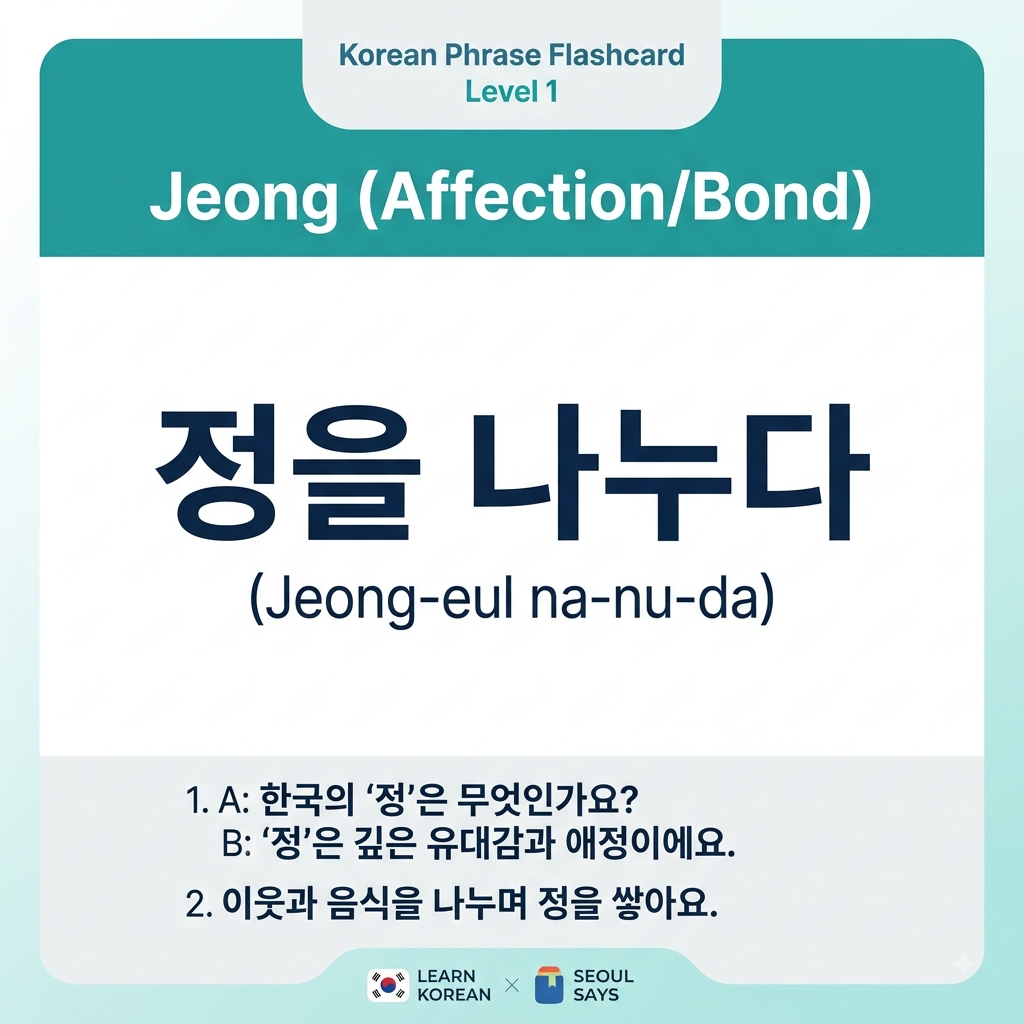
1. What Exactly is ‘Jeong’ (정)?
If you open a Korean-English dictionary, Jeong (정 / 情) is often translated as affection, attachment, warmth, sympathy, or bond. However, ask any Korean to define it, and they will tell you that a single English word falls short.
Jeong is an invisible emotional thread that develops over time between people, places, or even objects. It is not an intense, passionate emotion that flares up overnight like romantic love. Instead, it is a slow-burning, subconscious affection built through shared experiences, mutual care, lingering presence, and small, repeated acts of generosity.
The Psychology Behind Jeong: “We” Over “I”
To truly grasp Jeong, you must understand Korea’s collective culture. While Western cultures often emphasize individuality and explicit personal boundaries, traditional Korean society revolves around community. Jeong is the emotional glue that holds this communal spirit together. It turns strangers into acquaintances, acquaintances into friends, and friends into extended family (Sik-gu).
Interestingly, Jeong isn’t always purely positive or pleasant. It can encompass mixed feelings of pity, duty, nostalgia, and joint struggle. You can even feel Jeong toward someone you bicker with constantly!
2. Key Korean Expressions to Master ‘Jeong’
To express or recognize Jeong in everyday Korean conversations, here are the most important phrases you should know:
1) 정이 많다 (Jeong-i man-ta)
- Literal Meaning: “To have a lot of Jeong.”
- How to Use: Used to describe a person who is naturally warm-hearted, compassionate, empathetic, and generous.
- Example:“우리 할머니는 정이 정말 많으셔.”(Woori halmoni-neun jeong-i jeong-mal man-eusyeo.)Translation: “My grandmother is such a warm-hearted, caring person.”
2) 정 들었다 (Jeong deu-reo-tta)
- Literal Meaning: “Jeong has entered / grown.”
- How to Use: Said when you realize you have developed a deep emotional attachment to someone, a neighborhood, or even an old pair of shoes after spending a lot of time with them.
- Example:“이 동네를 떠나려니 정이 많이 들었나 봐요.”(I dong-ne-reul tteo-na-ryeo-ni jeong-i man-i deu-reon-na bwa-yo.)Translation: “Now that I’m leaving this neighborhood, I realize how attached I’ve grown to it.”
3) 정을 붙이다 (Jeong-eul bu-chi-da)
- Literal Meaning: “To stick/attach Jeong.”
- How to Use: To deliberately make an effort to settle into a new environment, job, or relationship and develop warmth toward it.
4) 정이 떨어지다 (Jeong-i tteo-reo-ji-da)
- Literal Meaning: “Jeong falls off / drops.”
- How to Use: Used when someone does something so disappointing, rude, or selfish that your affection and emotional attachment toward them instantly vanishes.
3. Real-Life Examples of ‘Jeong’ in Daily Korean Culture
How does Jeong show up in 21st-century modern Korea? Here are four classic real-life scenarios you will definitely experience:
🍲 1. The “Service” (덤 / 서비스) at Local Restaurants
When you frequent a small, family-run restaurant (Sik-dang), the owner might bring out an extra dish, an extra bowl of soup, or a soft drink and say, “이거 서비스예요!” (This is on the house!). This isn’t just a marketing tactic to get repeat customers; it’s an act of Jeong. The owner feels a sense of familiarity toward you and wants to ensure you leave full and happy.
🍱 2. Sharing Food & “Isat-tteok” (이사떡)
Food is the primary medium through which Koreans express Jeong. Historically, when someone moved into a new neighborhood, they made traditional rice cakes (Isat-tteok) and handed them out to neighbors to introduce themselves. Today, you’ll still see colleagues constantly sharing snacks, fruit, and coffee at the office without expecting anything in return.
🤝 3. The Difficulty of Saying “No” (정 때문에)
Have you ever wondered why Korean friends sometimes struggle to give a direct “No”? Often, it’s because of Jeong. Rejecting a request outright can feel like breaking an emotional bond or acting cold (Jeong-eop-da). Koreans often use soft rejections or go out of their way to help—even when inconvenient—out of Jeong.
🍫 4. The Choco Pie Phenomenon
If you purchase a box of Korea’s famous Orion Choco Pie, you’ll notice the Chinese character 情 (Jeong) printed boldly on the box. For decades, commercials featured subtle acts of kindness—a student leaving a Choco Pie on a bus driver’s seat, or a soldier sharing one with a buddy. The snack became a national symbol of unstated affection.
4. How to Build ‘Jeong’ as a Foreigner in Korea
Navigating social life in a foreign country can be intimidating, but understanding Jeong is your secret key to building lifelong friendships in Korea.
- Accept Kindness Gracefully: When a neighbor or local shopkeeper gives you extra food or help, accept it warmly with a smile and a sincere “Gamsahamnida!”
- Reciprocate Small Gestures: Jeong is a two-way street. If a coworker helps you with a difficult task, bring them an iced Americano the next morning. Small, non-monetary gestures build immense goodwill.
- Show Up Consistently: Frequency builds Jeong. Being a regular at a local cafe, attending community gatherings, or checking in on friends regularly naturally invites people to open their hearts to you.
Summary: The Hidden Warmth of Korea
While Korea is famous worldwide for ultra-modern technology, sleek K-pop aesthetics, and fast-paced city life (Pali-pali), its true soul resides in the quiet, enduring warmth of Jeong.
Next time an Ajumma gives you an extra side dish or a friend checks in on you out of nowhere, know that you are officially experiencing the heartbeat of real Korean culture!
🔗 Next Article
---

### 📚 Dive Deeper into Real Korean Culture & Language!

Enjoyed learning about **Jeong**? Master more authentic Korean expressions and workplace culture in our **Real Korean** series:

* ☕ **Part 2 (Daily Courtesy):** [The Art of 'Sugo-hamae-yo': How to Use Korea's Most Common Courtesy Phrase](https://seoulsays.com/sugohaseyo-korean-phrase-meaning-guide)
* 👀 **Part 3 (Social Etiquette):** [Reading the Room: What is 'Nunchi' and Why is it Essential in Korea?](https://seoulsays.com/korean-nunchi-culture-guide)

---
답글 남기기