If you have ever spent time working, studying, or hanging out with Korean friends, you may have heard them use a word that seems to pop up everywhere: Nunchi (눈치).
Sometimes it is praised as a social superpower (“She has such fast Nunchi!”), and other times it is used as a lighthearted warning (“Don’t look at their Nunchi too much!”).
At its core, Nunchi is the uniquely Korean art of reading the room—the ability to gauge the mood, emotions, and unspoken dynamics of a social situation in milliseconds, and adjusting your behavior accordingly to maintain harmony.
In a fast-paced, high-context society like South Korea, having strong Nunchi is considered just as important as high intelligence or professional skill. In this guide, we will break down what Nunchi really means, how it plays out in daily life, essential Korean phrases, and how you can use it to navigate social situations in Korea like a local!
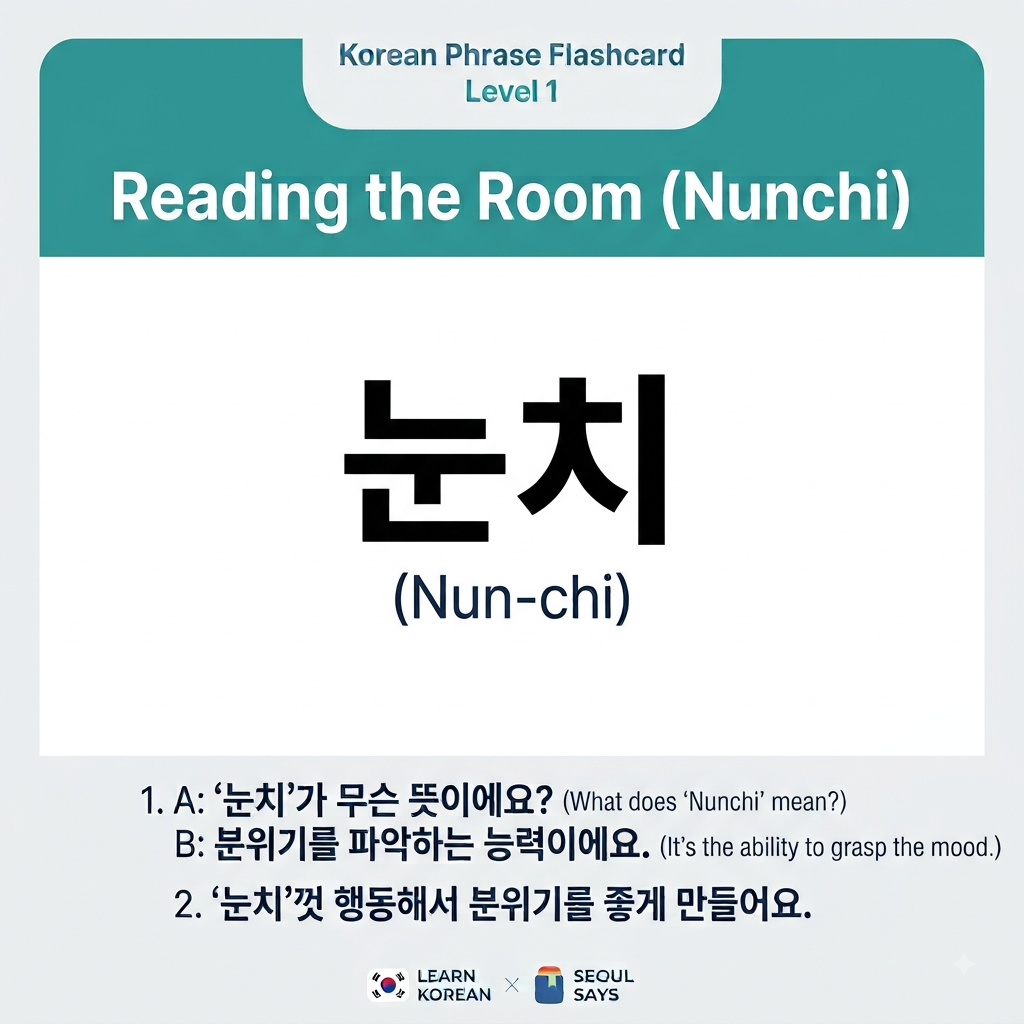
1. What Exactly is ‘Nunchi’ (눈치)?
Literally translated, Nun (눈) means “eye” and Chi (치) relates to “measure” or “tact.” Put them together, and Nunchi is the act of using your eyes to measure a room’s atmosphere without anyone having to say a single word out loud.
Unlike Western social norms that heavily favor direct, verbal communication—where people explicitly state what they want, feel, or expect—Korean culture relies heavily on high-context communication. Much of the meaning is conveyed between the lines: through tone of voice, body language, facial expressions, seating arrangements, and subtle pauses.
Nunchi is not about mind reading or telepathy. It is about keen observation, empathy, and social tact. A person with quick Nunchi instantly notices who is uncomfortable, who needs a refill on their drink, or whether the boss is having a stressful morning.
2. Key Korean Expressions Related to ‘Nunchi’
To sound like a native speaker when discussing social situations, here are the three most essential Nunchi expressions you should master:
1) 눈치가 빠르다 (Nun-chi-ga ppa-reu-da)
- Literal Meaning: “Nunchi is fast.”
- Meaning: To be quick-witted, observant, and socially adept. Someone who instantly picks up on unspoken cues and acts smoothly.
- Example:“지민이는 눈치가 정말 빨라서 같이 일하기 편해.”(Ji-min-i-neun nun-chi-ga jeong-mal ppa-rea-seo gat-i il-ha-gi pyeon-hae.)Translation: “Jimin has such quick Nunchi, so she’s really easy and comfortable to work with.”
2) 눈치가 없다 (Nun-chi-ga eop-da)
- Literal Meaning: “To have no Nunchi.”
- Meaning: To be tactless, oblivious, or slow to catch onto social cues. Someone who blurt out awkward comments at the wrong moment or stays too long when an host wants to wrap up.
- Example:“분위기 진지한데 혼자 농담하다니, 정말 눈치 없네.”(Bun-wi-gi jin-ji-han-de hon-ja nong-dam-ha-da-ni, jeong-mal nun-chi eop-ne.)Translation: “Making a joke when the mood is so serious? He really has no Nunchi.”
3) 눈치를 보다 (Nun-chi-reul bo-da)
- Literal Meaning: “To look at someone’s Nunchi.”
- Meaning: To tread carefully, read someone’s reaction, or worry about what others think before taking action.
- Example:“선배들 눈치 보느라 퇴근을 못 하고 있어.”(Seon-bae-deul nun-chi bo-neu-ra toe-geun-eul mot ha-go it-seo.)Translation: “I can’t leave work because I’m worried about my senior colleagues’ reactions.”
3. Real-Life Examples of ‘Nunchi’ in Korean Culture
How does Nunchi play out in real life? Here are three common scenarios where you will witness Nunchi in action:
🍻 1. The Korean After-Work Dinner (Hoesik)
At an after-work team dinner (Hoesik), a person with fast Nunchi shines effortlessly:
- They notice when the grill is running low on meat and order another portion before anyone asks.
- They see that a colleague’s glass is empty and naturally pour a refill.
- They notice the manager looking tired and subtly suggest wrapping up the evening (“Should we get ready for the next round?“) without making anyone feel rushed.
🚇 2. Riding the Subway or Bus
Subway cars during rush hour in Seoul are a masterclass in silent Nunchi:
- People glance around to see if an elderly passenger, pregnant woman, or person with heavy luggage has boarded near them.
- Standing commuters subtly adjust their posture or step aside so someone can exit smoothly through the sliding doors.
- Nobody speaks loudly on their phone because they pick up on the collective quiet atmosphere of the train car.
☕ 3. Ordering at a Busy Cafe or Restaurant
When ordering in a crowded Seoul cafe with a long line behind you, Nunchi dictates having your order and payment method ready before reaching the counter. Taking five minutes to decide while twenty people wait behind you is considered a classic example of Nun-chi eop-da (having no Nunchi).
4. The Fine Line: Good Nunchi vs. Excessive Nunchi
While having fast Nunchi makes you well-liked and smooth in social settings, there is a flip side to watch out for: overusing it.
When people spend too much energy constantly “looking at other people’s Nunchi” (Nun-chi bo-da), it can lead to unnecessary social anxiety, overthinking, and feeling like you cannot express your true opinion.
The goal is not to live in fear of what others think, but rather to use positive Nunchi as a tool for empathy—showing care and consideration for those around you so that everyone enjoys their time together.
Summary: Your Secret Weapon in Korea
Understanding Nunchi unlocks a whole new dimension of living, working, and socialing in South Korea. It shows that you respect local customs and care about the comfort of those around you.
Next time you find yourself in a Korean group setting, take a breath, look around, observe the subtle cues, and let your Nunchi guide you!
🔗 Related Article
---

### 📚 Explore More Real Korean Culture & Language Guides!

Master authentic expressions and cultural nuances with our **Real Korean** series:

* 🤝 **Part 1 (Heart of Relationships):** [Understanding 'Jeong' (정): The Unspoiled Heart of Korean Relationships](https://seoulsays.com/understanding-korean-jeong-culture-meaning)
* ☕ **Part 2 (Daily Courtesy):** [The Art of 'Sugo-haseyo': How to Use Korea's Most Common Courtesy Phrase](https://seoulsays.com/sugohaseyo-korean-phrase-meaning-guide)

---
답글 남기기