If you have watched any K-drama, listened to K-pop, or hung out with young Koreans in Hongdae or Seongsu-dong, you have definitely heard two iconic single-word exclamations: Dae-bak (대박) and Heol (헐).
These two words form the absolute backbone of modern Korean conversational slang. While textbooks often focus on formal vocabulary and polite grammar, everyday spoken Korean relies heavily on expressive emotional exclamations.
What makes these slang terms so fascinating is their incredible versatility: a subtle change in your vocal pitch, facial expression, or tone can transform “Dae-bak” from a genuine compliment into sarcastic disbelief, or turn “Heol” from mild surprise into deep sympathy.
In this guide, we will break down the origins, meanings, pitch variations, and real-life scenarios for Dae-bak, Heol, and their close companion Jinjja? (진짜?), giving you the exact blueprint to express instant emotion like a native Korean speaker!
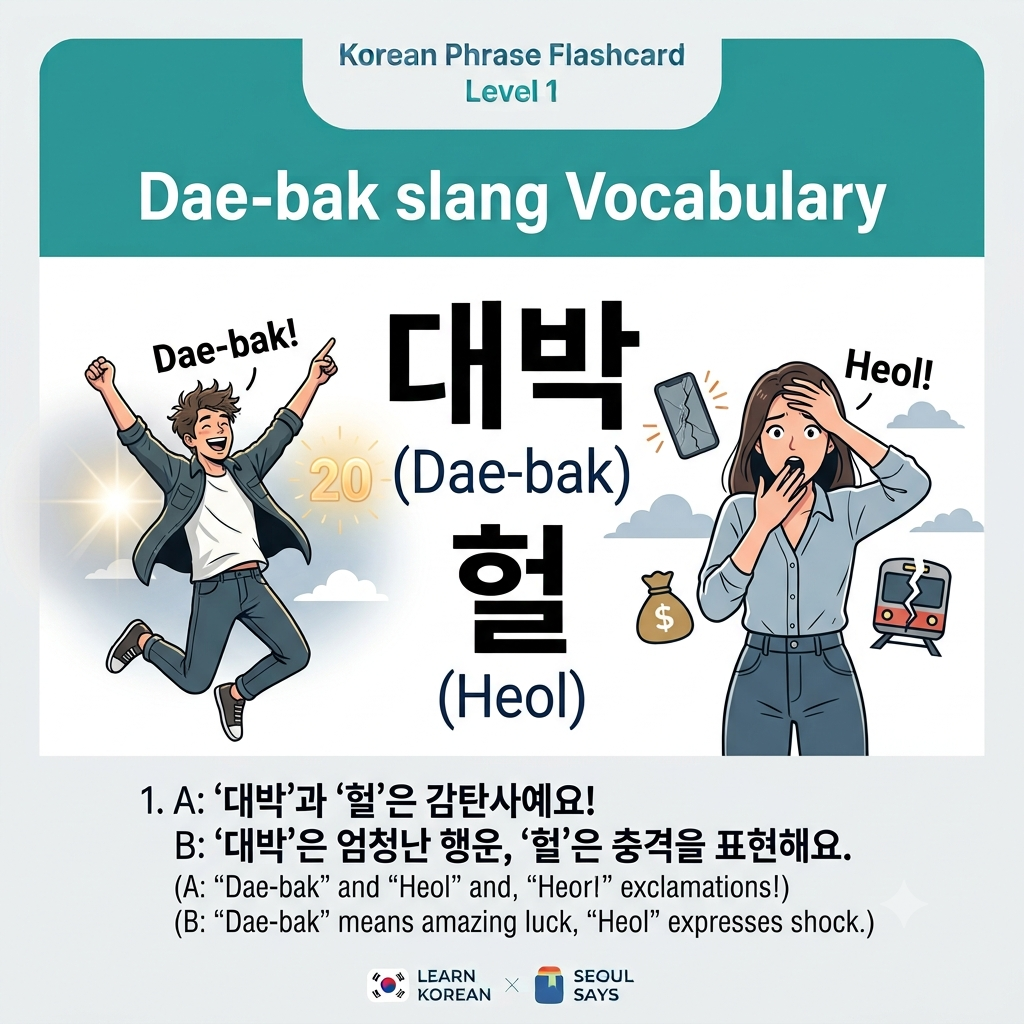
1. ‘Dae-bak’ (대박): The Ultimate Exclamation of Wonder
If you only learn one piece of Korean slang during your time in Korea, make it Dae-bak (대박).
Origin and Literal Meaning
Historically, the word Dae-bak stems from gambling and business contexts, combining Dae (대 / 大 – big) and Bak (박 – jackpot / fortune) to literally mean “a massive jackpot” or “huge success.” In modern slang, however, it has evolved into a universal reaction meaning:
“Jackpot!”, “Awesome!”, “Unbelievable!”, or “Mind-blowing!”
How Tone Changes the Meaning of ‘Dae-bak’
- High Pitch + Wide Eyes (Pure Excitement / Praise)
- Situation: Trying an amazingly delicious street food or hearing that your friend won concert tickets.
- Sound: “Dae-bak!” (Upward inflection, high energy)
- Meaning: “This is incredible!” / “No way, that’s awesome!”
- Low Pitch + Flat Tone (Shock / Disbelief)
- Situation: Hearing a shocking piece of gossip or finding out your favorite cafe closed permanently.
- Sound: “Dae… bak…” (Slow, drawn-out, falling tone)
- Meaning: “That is wild…” / “I can’t believe that happened…”
- Curious Rising Tone (Interrogative)
- Situation: Asking someone to confirm an incredible story.
- Sound: “Dae-bak?” (Questioning tone)
- Meaning: “Really? Was it really that crazy?”
2. ‘Heol’ (헐): The Sound of Pure Speechlessness
While Dae-bak leans heavily toward big events and major news, Heol (헐) is the ultimate, quick-reaction filler word used when you are caught off guard.
Meaning and Nuance
There is no direct single-word equivalent in English, but it functions identically to:
“OMG”, “Whoa”, “Yikes”, “WTF”, or “No way…”
It expresses the exact moment your brain pauses because something unexpected, ridiculous, sad, or mind-boggling just occurred.
Real-Life Scenarios for Using ‘Heol’
- Dropping your phone face down on the concrete:“Heol!” (Short, sharp gasp)
- Checking your bank account after a night out in Gangnam:“Heol… where did all my money go?” (Soft, defeated sigh)
- Hearing that your train was delayed by 30 minutes:“Heol, really?” (Frustrated tone)
3. The Secret Weapon: ‘Jinjja?’ (진짜?)
To make your reactions sound 100% natural, you need to combine Dae-bak and Heol with Korea’s most famous reaction phrase: Jinjja? (진짜?).
Meaning
- Jinjja (진짜): “Real” or “Seriously?”
The Legendary Korean Reaction Combo
When Koreans listen to a friend telling a story, they naturally chain these three words together to show active listening (Chu-im-sae / 추임새):
Plaintext
Friend: "Yesterday I ran into our high school teacher at Starbucks!"
You: "Jinjja?" (진짜? / Seriously?)

Friend: "Yeah! And he bought my coffee and gave me a $100 gift card!"
You: "Heol! Dae-bak!" (헐! 대박! / Whoa! That's insane!)
Mastering this three-step reaction combo instantly makes conversation flow smoothly without needing complex grammar!
4. Etiquette Note: When NOT to Use ‘Dae-bak’ or ‘Heol’
Because both Dae-bak and Heol are casual slang (Ban-mal), using them in the wrong context can sound informal or unprofessional.
- ❌ Avoid using with: University professors, senior bosses, elderly people, or during formal job interviews.
- ⭕ Safe to use with: Friends, peers of similar age, younger colleagues, or informal social gatherings (Hoesik).
If you want to express excitement politely to a boss or senior, use:
“정말 대단하네요!” (Jeong-mal dae-dan-ha-ne-yo! / That is truly impressive!)
Summary: Speak Like a Local
Language learning isn’t just about textbook grammar—it’s about capturing the emotional rhythm of real people.
Next time something amazing, shocking, or utterly weird happens, skip the long dictionary sentences and go straight for “Dae-bak!” or “Heol!” You’ll immediately feel the instant connection with native speakers around you!
🔗 Related Article
— ### 📚 Explore More Real Korean Culture & Language Guides! Master authentic expressions and cultural nuances with our **Real Korean** series: * 🤝 **Part 1 (Heart of Relationships):** [Understanding ‘Jeong’ (정): The Unspoiled Heart of Korean Relationships](https://seoulsays.com/understanding-korean-jeong-culture-meaning) * ☕ **Part 2 (Daily Courtesy):** [The Art of ‘Sugo-haseyo’: How to Use Korea’s Most Common Courtesy Phrase](https://seoulsays.com/sugohaseyo-korean-phrase-meaning-guide) * 👀 **Part 3 (Reading the Room):** [What is ‘Nunchi’ (눈치)? The Essential Guide to Reading the Room in Korea](https://seoulsays.com/korean-nunchi-culture-guide) * 🏠 **Part 4 (Communal Mindset):** [Why Koreans Say ‘Our Mom’ Instead of ‘My Mom’: Understanding ‘Woori’ (우리)](https://seoulsays.com/why-koreans-say-woori-our-mom-meaning) —
답글 남기기