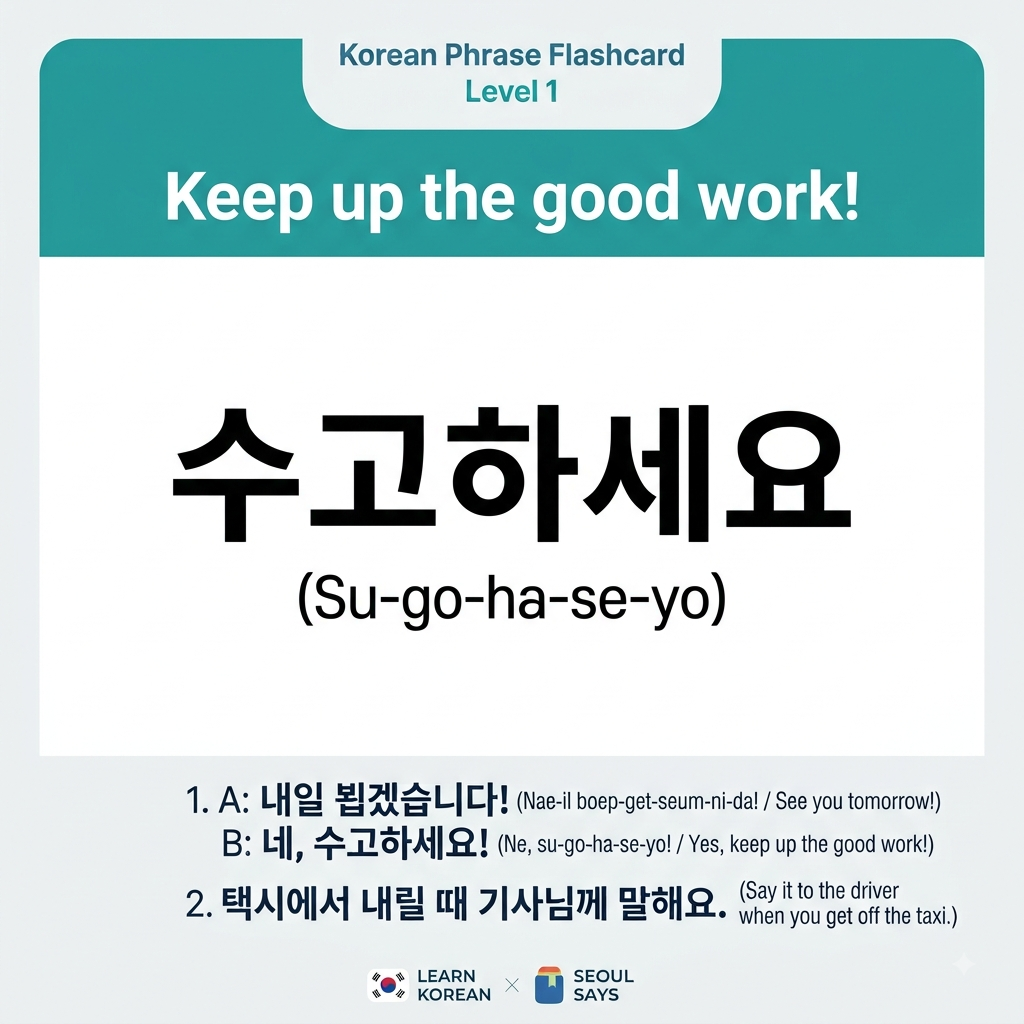
If you’ve spent even a single day in South Korea, you have almost certainly heard the phrase “Sugo-haseyo” (수고하세요).
You’ll hear a passenger softly say it to a driver while hopping off a Seoul taxi. You’ll hear a customer drop it at the counter when leaving a convenience store with a warm can of coffee. And in any office across Korea, you’ll hear employees tossing it back and forth as they wrap up their workday.
If you plug it into Google Translate, it often outputs as “Keep up the good work” or “Trouble yourself.” But these mechanical translations completely miss the cultural warmth behind the phrase.
In this guide, we’ll demystify the true meaning of Sugo-haseyo, teach you how to use its past-tense forms, and explain the crucial social etiquette rule that every foreigner in Korea needs to know!
1. What Does “Sugo” (수고) Actually Mean?
To understand the phrase, we have to look at the core noun: Sugo (수고 / 辛苦).
Historically, Sugo translates to trouble, hard work, effort, or labor. When combined with the honorific verb endings, you are literally acknowledging and validating the physical or mental effort someone is exerting on your behalf or for a shared goal.
Instead of a generic “Thank you” (Gamsahamnida) or “Goodbye” (Annyeonghi gyeseyo), saying Sugo-haseyocommunicates something much deeper:
“I recognize the effort you are putting into your work, and I respect your labor.”
It is the ultimate expression of daily courtesy in Korean society, bridging the gap between customer and service worker, or colleague and colleague.
2. When and Where to Use “Sugo-haseyo”
Here are the most common real-life scenarios where you can naturally drop this phrase like a true local:
🚕 1. Leaving a Taxi
When arriving at your destination, hand over your payment and say “Sugo-haseyo!” as you open the door. It shows appreciation for the driver navigating through heavy traffic to get you there safely.
🏪 2. Exiting Convenience Stores or Shops
After grabbing your items at a CU, GS25, or Seven-Eleven, say “Sugo-haseyo!” to the cashier as you pick up your bag. It functions as a polite, respectful way of saying “Have a good shift!”
📦 3. Greeting Delivery Drivers (Taek-bae)
Korea’s legendary same-day delivery culture thrives on the hard work of delivery drivers. If you hand off a package or meet a driver at your front door, a warm “Sugo-haseyo!” goes a very long way.
3. Past vs. Present: Choosing the Right Form
Timing and tense matter in Korean! Using the wrong variation can sound slightly unnatural, so keep this simple breakdown in mind:
1) 수고하세요 (Su-go-ha-se-yo) — Present / Ongoing
- When to use: When the other person is still working while you are leaving.
- Example: You leave the convenience store, but the clerk continues working. You leave the office at 5 PM, but your colleague is still at their desk typing.
2) 수고하셨습니다 (Su-go-ha-syeot-seum-ni-da) — Past / Completed
- When to use: When a shared task, meeting, or event has just finished for everyone involved.
- Example: At the end of a long team meeting, after filming a video shoot, or at the end of a sports match where everyone worked hard together.
4. The Golden Rule: Never Say “Sugo-haseyo” to Your Boss!
This is where many non-native speakers accidentally commit a major social faux pas.
Traditionally, acknowledging someone’s “trouble” or praising their “hard work” carried an implicit sense of evaluation—something a person in authority does for a subordinate. Because of this historical nuance, saying “Sugo-haseyo” to your boss, manager, or an elderly elder can sound condescending, as if you are appraising their performance!
❌ Incorrect (To Your Boss when leaving work):
“Boss, sugo-haseyo!”
(This can sound like: “Keep working hard, boss!”)
⭕ Correct Polite Alternatives for Bosses & Seniors:
- When leaving the office before your boss:“먼저 퇴근해보겠습니다. 내일 뵙겠습니다!”(Meon-jeo toe-geun-hae-bo-get-seum-ni-da. Nae-il boep-get-seum-ni-da.)Translation: “I am heading home first. I will see you tomorrow!”
- When thanking a senior for their hard work after a big project:“애쓰셨습니다!” (Ae-sseu-syeot-seum-ni-da!) or“고생 많으셨습니다!” (Go-saeng man-eu-syeot-seum-ni-da!)Translation: “Thank you for your immense effort and dedication!”
Summary: A Small Phrase with Big Respect
Mastering Sugo-haseyo is one of the fastest ways to show that you understand the heart of Korean etiquette. It takes less than two seconds to say, but it immediately signals kindness, empathy, and respect to everyone serving or working around you.
The next time you grab your morning coffee or take a late-night taxi ride home, give it a try—you’ll almost certainly see a warm, appreciative smile in return!
🔗 Next Article
---

### 📚 Explore More Real Korean Culture & Language Guides!

Expand your understanding of Korean social nuances with our latest articles:

* 🤝 **Part 1 (Heart of Relationships):** [Understanding 'Jeong' (정): The Unspoiled Heart of Korean Relationships](https://seoulsays.com/understanding-korean-jeong-culture-meaning)
* 👀 **Part 3 (Social Etiquette):** [Reading the Room: What is 'Nunchi' and Why is it Essential in Korea?](https://seoulsays.com/korean-nunchi-culture-guide)

---
답글 남기기