If you have been studying Korean slang through older textbooks or classic K-dramas, you are probably familiar with staple exclamations like Daebak (대박 – Awesome) and Heol (헐 – OMG/Yikes).
While these terms are still universally understood across all age groups in Korea, the linguistic landscape among Korean Gen Z and Gen Alpha (10s and 20s) moves at lightning speed. On TikTok, Instagram Reels, YouTube Shorts, and X (formerly Twitter), classic slang can sometimes sound a bit dated or “30s-40s style.”
Today’s youth in Seoul have created a whole new layer of hyper-expressive slang to capture moments of awe, utter absurdity, and unexpected drama.
In this guide, we will dive deep into the real-time slang trending across Korea right now—explaining how to substitute Daebak and Heol with modern equivalents like Pom Mi-chyeot-da, Sil-hwa-nya, Eok-kka, and GOAT like a true local insider!
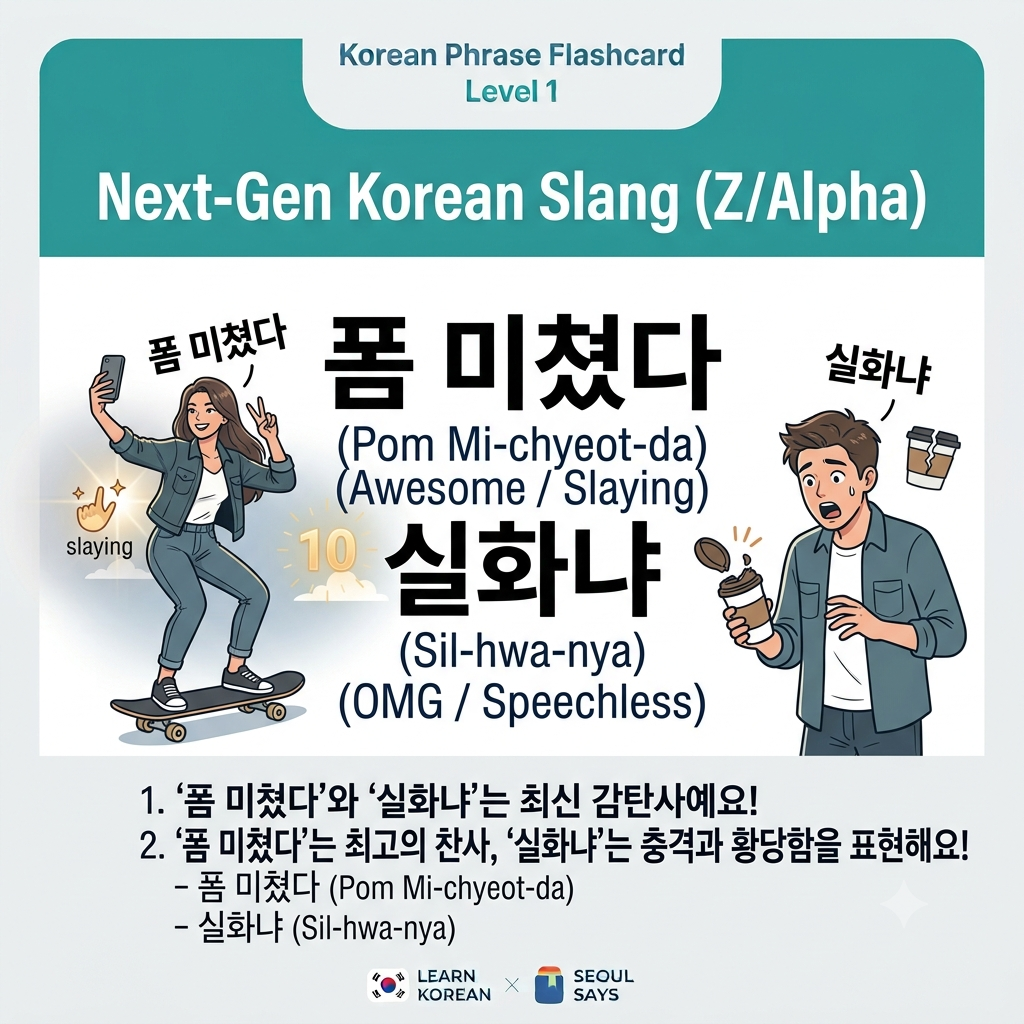
1. Upgrading ‘Daebak’: How Gen Z Expresses Absolute Awe
When something is mind-blowing, visually stunning, or insanely impressive, modern youth rarely rely on a simple “Daebak!” anymore. Here is how they level up their praise:
1) 폼 미쳤다 (Pom Mi-chyeot-da)
- Literal Translation: “Form is crazy / Form has gone insane.”
- Meaning: “Their skill/visuals/performance is next-level!” or “They are absolutely slaying!”
- Context: Originally originating from sports commentary referring to an athlete’s peak form, it quickly spread to K-pop, fashion, and daily life.
- Example:“오늘 제니 콘서트 비주얼 폼 미쳤다!”(O-neul Jennie concert visual pom mi-chyeot-da!)Translation: “Jennie’s visuals at today’s concert are absolutely insane!”
2) 지린다 (Ji-rin-da)
- Literal Translation: “To wet one’s pants” (vulgar/raw origins, now mainstream slang).
- Meaning: “That was so epic/intense it gave me chills.”
- Context: Used when witnessing an overwhelmingly impressive talent, vocal range, or high-level skill.
- Example:“방금 보컬 고음 부분 진짜 지린다…”(Bang-geum vocal go-eum bu-bun jin-jja ji-rin-da…)Translation: “That vocal high note just now was ridiculously epic…”
3) GOAT (고트)
- Meaning: “Greatest Of All Time.”
- Context: Korean Gen Z adopted this global English acronym directly into spoken Korean to crown someone as an absolute legend in their field.
- Example:“오늘 손흥민 경기 봤어? 진짜 GOAT다.”(O-neul Son Heung-min gyeong-gi bwat-seo? Jin-jja GOAT-da.)Translation: “Did you see Son Heung-min’s match today? He is a total GOAT.”
4) 개~ (Gae-) as an Intensive Prefix
- Meaning: “Super,” “Insanely,” or “Crazy good.”
- Context: Instead of saying “Daebak taste!”, young Koreans attach the prefix Gae- directly to adjectives:
- 개맛있다 (Gae-mas-it-da): Insanely delicious.
- 개좋다 (Gae-joh-da): Super awesome / I love it so much.
- 개멋있다 (Gae-meos-it-da): Super cool.
2. Upgrading ‘Heol’: How Gen Z Reacts to Shock & Ridiculousness
When things go wrong, get weird, or leave you completely speechlessness, Heol is replaced by these punchy, dramatic reactions:
1) 실화냐? (Sil-hwa-nya?) / 이거 맞냐? (I-geo mat-nya?)
- Literal Translation: “Is this a true story?” / “Is this right?”
- Meaning: “Are you serious right now?” / “Is this real life?”
- Context: Used during unexpected plot twists, sudden bad luck, or absurd announcements.
- Example:“콘서트 티켓 1초 만에 매진된 거 실화냐?”(Concert ticket 1-cho man-e mae-jin-doen geo sil-hwa-nya?)Translation: “Concert tickets sold out in 1 second… is this for real?”
2) 억까 (Eok-kka)
- Literal Translation: Abbreviation of “Eok-ji Kka-gi” (forced hate/unfair bad luck).
- Meaning: “Unfair misfortune,” “The universe is praying on my downfall,” or “Pure bad luck.”
- Context: Used when the odds seem stacked against you in a comical or frustrating way.
- Example:“지하철 탈 때마다 바로 앞에서 문 닫히네… 진짜 억까다.”(Ji-ha-cheol tal ttae-ma-da ba-ro ap-e-seo mun dat-hi-ne… jin-jja eok-kka-da.)Translation: “Every single time I try to get on the subway, the doors close right in front of me… I’m being targeted by bad luck.”
3) 레전드 (Legend)
- Meaning: “A legendary disaster” or “An absurdly memorable moment.”
- Context: While “legend” sounds positive in English, young Koreans often use it sarcastically when someone makes an unbelievable mistake or experiences epic bad luck.
- Example:“오늘 정신없어서 핸드폰 두고 출근함… 진짜 레전드다.”(O-neul jeong-sin-eop-seo-seo phone du-go chul-geun-ham… jin-jja legend-da.)Translation: “I was so distracted today I left my phone at home and went to work… what a legendary mess.”
3. Universal Gen Z Mindset Exclamations
Beyond reactions, two versatile phrases dominate modern Korean social media culture:
1) 미쳤다 / 미침 (Mee-chyeot-da / Mee-chim)
- Meaning: “Crazy!” / “Insane!”
- How it works: This has effectively taken over as the single most common filler exclamation in modern Korea. Depending on your tone of voice:
- High tone: “Mee-chyeot-da!” ➔ “This food/song is insanely good!”
- Low tone: “Mee-chyeot-da…” ➔ “This situation is totally ruined/crazy.”
2) 오히려 좋아 (O-hi-reo Joh-a)
- Literal Translation: “Actually, this is better!” / “Even better!”
- Meaning: “Look on the bright side!” or “Plot twist: I like this better anyway!”
- Context: A popular positive-mindset meme phrase used when plans change unexpectedly, but you turn it into a win.
- Example:“비 와서 야외 카페 대신 실내 보드게임 카페 왔는데? 오히려 좋아!”(Rain forced us inside to a board game cafe instead? Even better!)
4. Etiquette Guide: Navigating Next-Gen Slang
Slang creates instant bonding among peers, but timing and age dynamics are crucial in Korea’s hierarchical society:
- ⭕ Ideal Contexts: K-pop fan communities, friends your own age, younger peers, gaming chats, Instagram comments, and casual student gatherings.
- ❌ Avoid Contexts: Formal business meetings, interviews, email correspondence with clients, or speaking to professors, bosses, and older relatives.
Summary: Keep Your Korean Fresh!
Language in Korea evolves as fast as its technology and pop culture. While mastering classic phrases builds your foundation, adding trending expressions like “Pom Mi-chyeot-da” and “Sil-hwa-nya?” to your vocabulary will show native speakers that you are truly plugged into modern Korean lifestyle!
🔗 Related Article
---

### 📚 Explore More Real Korean Culture & Language Guides!

Master authentic expressions and cultural nuances with our **Real Korean** series:

* 🤝 **Part 1 (Heart of Relationships):** [Understanding 'Jeong' (정): The Unspoiled Heart of Korean Relationships](https://seoulsays.com/understanding-korean-jeong-culture-meaning)
* ☕ **Part 2 (Daily Courtesy):** [The Art of 'Sugo-haseyo': How to Use Korea's Most Common Courtesy Phrase](https://seoulsays.com/sugohaseyo-korean-phrase-meaning-guide)
* 👀 **Part 3 (Reading the Room):** [What is 'Nunchi' (눈치)? The Essential Guide to Reading the Room in Korea](https://seoulsays.com/korean-nunchi-culture-guide)
* 🏠 **Part 4 (Communal Mindset):** [Why Koreans Say 'Our Mom' Instead of 'My Mom': Understanding 'Woori' (우리)](https://seoulsays.com/why-koreans-say-woori-our-mom-meaning)
* 🔥 **Part 5 (Classic Reactions):** [Master Korean Slang: How to Use 'Dae-bak' & 'Heol' Like a Native](https://seoulsays.com/master-korean-slang-daebak-heol-meaning)

---
답글 남기기