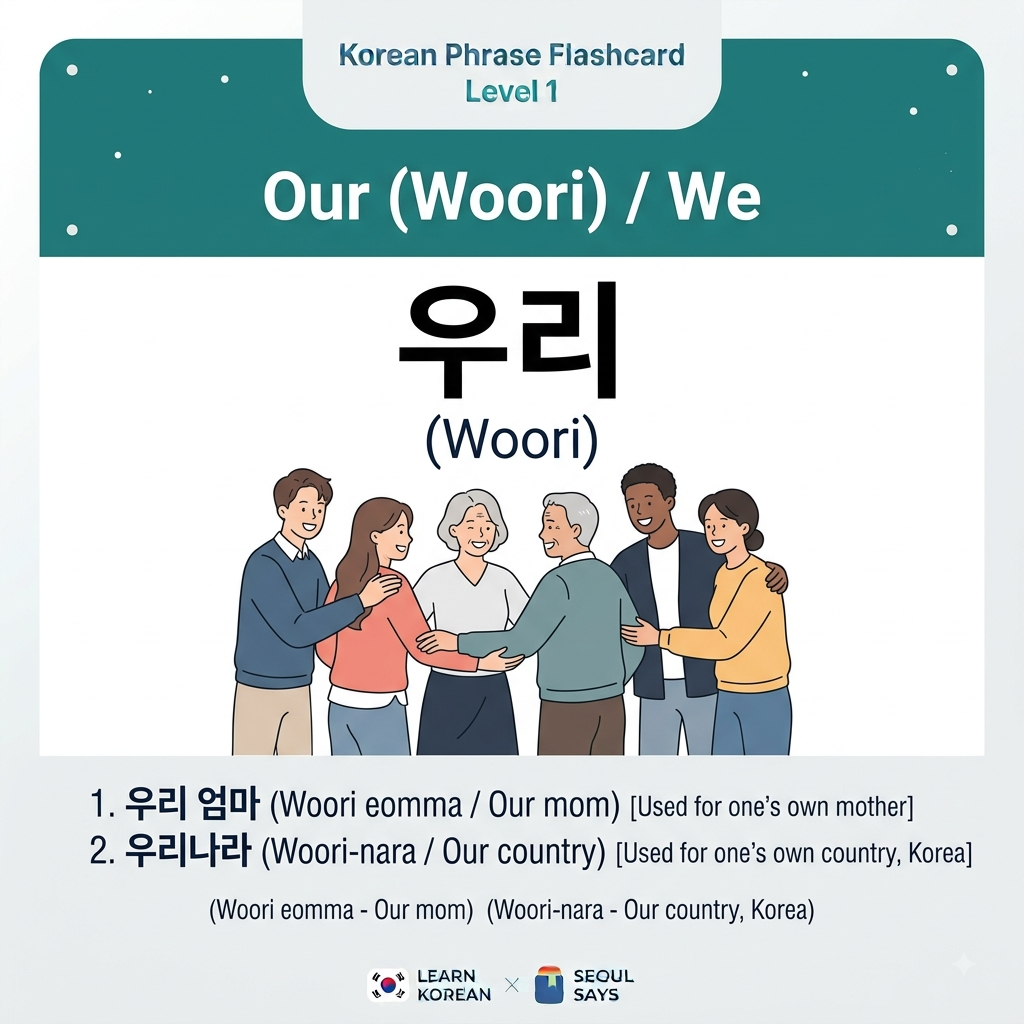
If you have been studying Korean for a while or spending time with native speakers, you may have noticed an unusual linguistic habit that pops up almost constantly in daily conversation.
When a Korean person introduces their mother, they won’t say “My mom” (Nae eomma / 내 엄마). Instead, they will almost always say “Our mom” (Woori eomma / 우리 엄마)—even if they are an only child speaking to a total stranger!
The same logic applies across many areas of life. Koreans say “Our country” (Woori nara / 우리나라), “Our home”(Woori jip / 우리 집), “Our school” (Woori hak-gyo / 우리 학교), and even “Our husband” (Woori nam-pyeon / 우리 남편)!
For visitors coming from individualistic cultures where personal property and clear boundaries are deeply woven into the language, hearing someone refer to their single spouse as “Our husband” can sound confusing or downright hilarious.
In this guide, we will unpack the deep cultural psychology behind the word Woori (우리), explore its most common real-life uses, breakdown essential vocabulary, and show you how adopting this single word will instantly make you sound more warm and native in Korean!
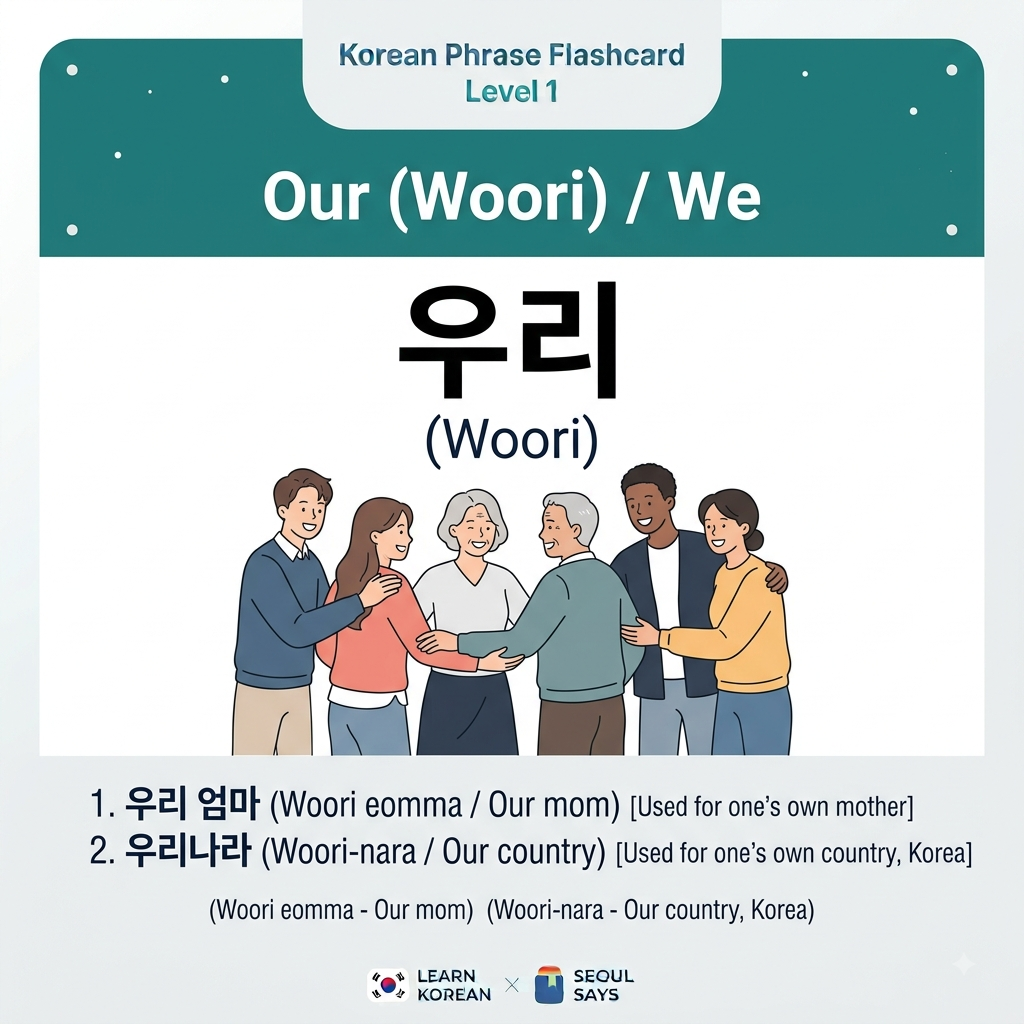
1. What Does ‘Woori’ (우리) Mean?
In basic dictionaries, Woori (우리) translates directly to “We,” “Us,” or “Our.”
However, in Korean culture, Woori goes far beyond a simple plural pronoun. It represents a communal mindset built on shared identity, belonging, and emotional warmth.
Historically, Korea was an agrarian, village-based society that relied heavily on collective farm labor known as Pum-asi(품앗이) and Dure (두레). Survival, harvest, and security depended not on individual solitude, but on the strength of the entire community working together. Over centuries, this collective consciousness bonded people into a single, extended emotional ecosystem where the group took precedence over the single individual.
When a Korean uses Woori, they are subtly inviting you into their sphere of belonging. It signifies:
“We belong to the same circle, we share this bond, and you are welcome here.”
2. Key Korean Expressions Using ‘Woori’ (우리)
Here are the most common expressions you will hear every day in Korea, along with their cultural nuances:
1) 우리 엄마 / 우리 아빠 (Woori eomma / Woori appa)
- Literal Translation: “Our Mom / Our Dad”
- Actual Meaning: “My Mom / My Dad”
- Cultural Context: Saying “Nae eomma” (My mom) can sound surprisingly distant, overly self-centered, or emotionally cold to Korean ears. Using Woori framing places the family inside a warm, shared social unit.
- Example:“우리 엄마가 만든 김치는 진짜 맛있어!”(Woori eomma-ga man-deun kim-chi-neun jin-jja mas-it-seo!)Translation: “My mom’s homemade kimchi is ridiculously delicious!”
2) 우리나라 (Woori-nara)
- Literal Translation: “Our Country”
- Actual Meaning: “Korea” (when spoken by a Korean person)
- Cultural Context: Koreans rarely refer to their homeland as Han-guk (South Korea) when speaking among themselves or to foreigners in Korean. They almost instinctively say Woori-nara. It evokes a strong sense of national pride and shared heritage.
- Example:“우리나라의 가을 날씨는 davvero 아름다워요.”(Woori-nara-ui ga-eul nal-ssi-neun a-reum-da-wo-yo.)Translation: “The autumn weather in our country (Korea) is truly beautiful.”
3) 우리 집 (Woori jip)
- Literal Translation: “Our House / Our Home”
- Actual Meaning: “My House / My Place”
- Cultural Context: Inviting someone to “Woori jip” isn’t just about showing off physical square footage; it is an invitation to step inside your personal sanctuary and share food or tea as part of the extended circle.
- Example:“이번 주말에 우리 집에 놀러 올래?”(I-beon ju-mal-e woori jip-e nol-leo ol-lae?)Translation: “Do you want to hang out at my place this weekend?”
4) 우리 회사 / 우리 학교 (Woori hoesa / Woori hak-gyo)
- Literal Translation: “Our Company / Our School”
- Actual Meaning: “My workplace / My university”
- Cultural Context: Expresses team loyalty and shared responsibility among coworkers or fellow alumni.
3. “My Husband” vs. “Our Husband”: The Funny Nuance
One of the most famous cultural jokes among foreigners learning Korean is the phrase Woori Nam-pyeon (우리 남편).
To an English speaker, hearing a married woman say “Our husband” might sound like a surprising admission of polygamy! But rest assured: no one is sharing a spouse.
Because Woori has evolved into an automatic prefix for close social relationships, Korean women naturally default to “Woori nam-pyeon” or “Woori a-nae” (our wife) as a customary token of affection. It simply communicates “the husband of our household unit.”
4. How ‘Woori’ Connects to Korean ‘Jeong’ (정)
If you read our previous post on Jeong (정)—the invisible emotional bond that unites Korean society—you will quickly notice how closely Woori and Jeong are linked.
- Woori defines the boundary: Who is part of our shared group?
- Jeong is the feeling that fills that space: The warm affection and care that keeps the group together.
When you start using Woori naturally in your conversations, native speakers will instantly sense that you understand the emotional heartbeat of Korean culture. It signals that you are not just viewing Korea as an outsider, but actively stepping into the warmth of the community!
Summary: From “I” to “We”
Language is a direct mirror of a society’s soul. While Western languages prioritize the individual “I”, the Korean language embraces the collective “We”.
The next time you talk about your favorite restaurant, your family, or your hometown in Korean, try swapping out “Nae”(My) for “Woori”. You’ll be amazed at how much warmer your Korean sounds!
🔗 Related Article
---

### 📚 Explore More Real Korean Culture & Language Guides!

Master authentic expressions and cultural nuances with our **Real Korean** series:

* 🤝 **Part 1 (Heart of Relationships):** [Understanding 'Jeong' (정): The Unspoiled Heart of Korean Relationships](https://seoulsays.com/understanding-korean-jeong-culture-meaning)
* ☕ **Part 2 (Daily Courtesy):** [The Art of 'Sugo-haseyo': How to Use Korea's Most Common Courtesy Phrase](https://seoulsays.com/sugohaseyo-korean-phrase-meaning-guide)
* 👀 **Part 3 (Reading the Room):** [What is 'Nunchi' (눈치)? The Essential Guide to Reading the Room in Korea](https://seoulsays.com/korean-nunchi-culture-guide)

---
답글 남기기