If you have ever had a conversation with a native Korean speaker—whether online, at a language exchange, or upon arriving in Seoul—you might have experienced a slightly startling moment. Within the first five minutes of meeting, they look at you with genuine curiosity and ask: “How old are you?”
In many Western cultures, asking someone’s age upfront can be perceived as nosy, overly personal, or even rude. However, in South Korea, this question is almost mandatory. It is not an invasive interrogation into your personal life, nor is it a way to judge you.
Instead, asking for your age is a foundational step in building a polite relationship. It is the compass that guides how people talk to each other.
In this comprehensive guide, we will unpack the fascinating cultural story behind South Korea’s age-oriented social structure and teach you the most useful, entry-level expressions to navigate your first introduction like a true local.
The Cultural Story: Why Age is the Universal Compass in Korea
To understand why age matters so much, we have to look at Confucianism, a philosophical and ethical system that has deeply shaped Korean society for hundreds of years. Confucianism places a heavy emphasis on social harmony, respect for elders, and understanding one’s specific place within a social hierarchy.
In the English language, you can use the word “you” to address a 5-year-old child, your college classmate, your boss, or the president of a country. The word remains identical, and the sentence structure rarely changes based on who you are speaking to.
Korean, however, does not work this way. The entire linguistic structure of the Korean language changes depending on who you are talking to.
When Koreans ask for your age, they are actually performing a polite, internal calculation to answer two essential questions:
- Should I use Jondetmal (존댓말 – Polite/Honorific speech) or Banmal (반말 – Casual/Informal speech)?
- What title or pronoun should I use to address this person?
Therefore, when a Korean person asks your age, they are trying to be respectful. They want to make sure they do not accidentally use casual language with someone older than them, which is considered a major social mistake. It is the beginning of careful communication and a sign of consideration.
Essential Beginner Expressions for Navigating Age
Now that you understand the cultural “why,” let’s look at the actual vocabulary and sentences you need to know. As a beginner, mastering these basic phrases will immediately make you sound more polite and culturally aware.
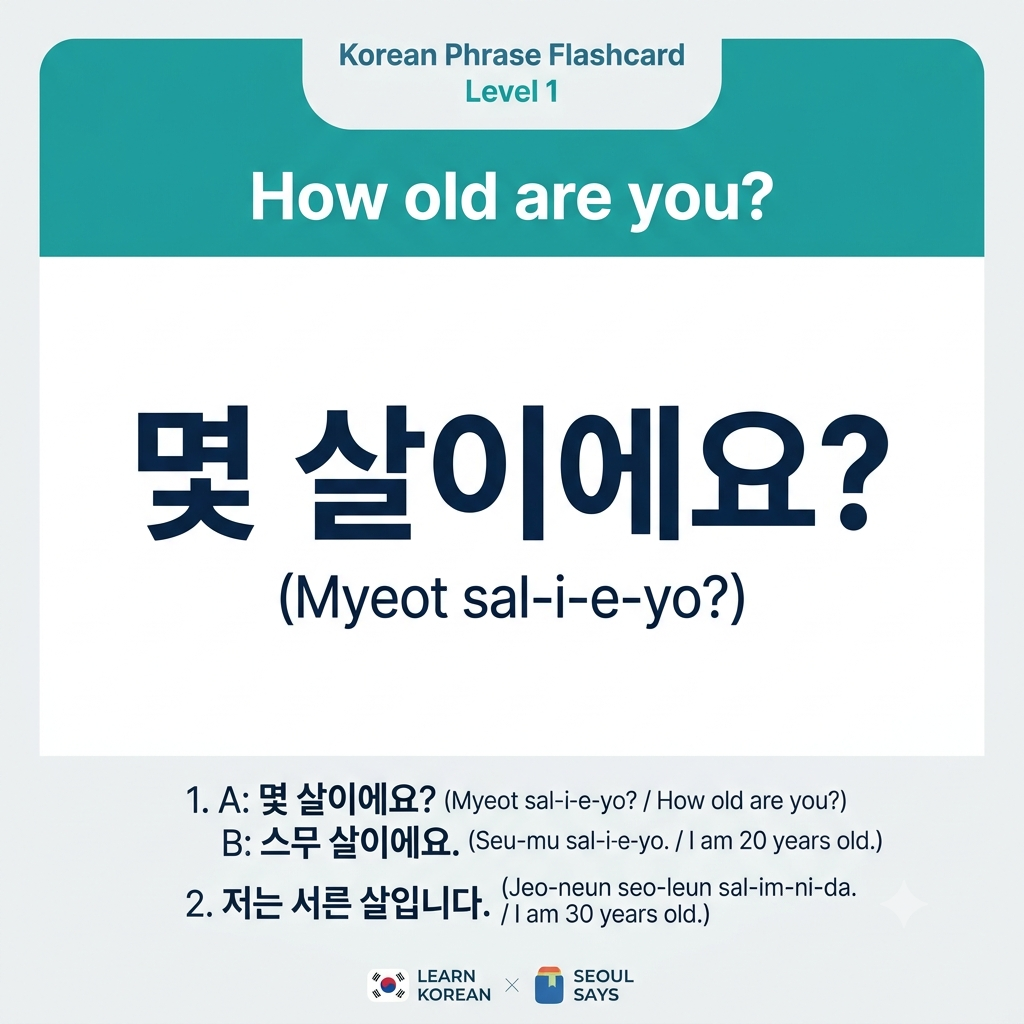
1. How to Ask and Answer Someone’s Age
When you want to ask someone’s age politely, there is a standard phrase you should use. Avoid using casual slang until you are deeply close with the person.
- How to Ask (Polite):
- 몇 살이세요? (Myeot sal-iseyo?)
- Meaning: How old are you?
- How to Answer (Polite):
- [Your Age]살이에요. ([Age] sal-ieyo.)
- Meaning: I am [Age] years old.
💡 Seoul Script Tip: If you want to say your age in Korean, you will need to learn Native Korean numbers (하나, 둘, 셋…). For example, if you are 25, you would say: “스물다섯 살이에요 (Seumul-daseot sal-ieyo).” If numbers are too tricky for now, simply saying the number in English or writing it down works perfectly too!
The Master Class on Using “~씨” (Mr. / Ms. / Mrs.)
In Western culture, when you want to address someone politely but don’t know them well, you use their last name, like “Mr. Smith” or “Ms. Davis.”
In Korea, one of the most common mistakes foreigners make is applying this rule directly to Korean names. They might call someone “Kim-ssi” (김씨). However, calling someone by just their last name + 씨 can actually sound incredibly rude, disrespectful, or condescending.
Here is the golden rule for using ~씨 (ssi) correctly:
| How to Attach | Example | How It Sounds to a Korean |
| First Name + 씨 | 민수 씨 (Minsu-ssi) | Perfect & Polite. Ideal for coworkers, classmates, or acquaintances of similar age. |
| Full Name + 씨 | 김민수 씨 (Kim Minsu-ssi) | Formal & Clear. Very safe, polite, and commonly used in business or official settings. |
| Last Name + 씨 | 김 씨 (Kim-ssi) | Impolite / Rude. Sounds like you are talking down to someone who is lower status than you. Avoid this! |
Quick Reference: Social Hierarchy Cheat Sheet
To help you visualize how age and social status work together in daily conversations, keep this simple structural breakdown in mind:
[Older Person or Higher Status] ───► Uses Casual Speech (Banmal) ───► To Younger Person
                                                                           │
[Younger Person or Lower Status] ──► Uses Polite Speech (Jondetmal) ──► To Older Person
- If they are older than you (even by just 1 year): You should automatically use polite language (Jondetmal) ending in ~요 (~yo) or ~습니다 (~seumnida).
- If you are the exact same age: You are considered 친구 (Chingu – Friend). In Korea, “friend” doesn’t just mean someone you like; it specifically means someone born in the exact same year. Once you establish that you are the same age, you can ask each other: “말 놓으셔도 돼요 (You can speak comfortably/casually with me).”
The “Korean Age” System vs. International Age
To make things even more interesting, you should know that how Koreans calculate their age has historically been completely different from the rest of the world. If you’ve ever talked to a Korean friend who said, “I am 26 in Korea, but 24 internationally,” here is why.
Traditionally, South Korea used a unique system called “Korean Age” (한국어 나이 – Hanguk-na-i). Under this traditional system:
- You are born at 1 year old. Koreans consider the time spent in the mother’s womb as the first year of life.
- Everyone turns a year older on New Year’s Day (January 1st), not on their actual birthday.
This means if a baby was born on December 31st, they would be 1 year old at birth. Then, the very next day on January 1st, they would turn 2 years old—despite only being alive for two days!
| Birth Date | International Age | Traditional Korean Age |
| December 31st | 0 years old | 1 year old |
| January 1st (Next Day) | 0 years old (2 days old) | 2 years old |
⚠️ The Big Change: Modern “Universal Age” Law
Because having multiple age systems caused confusion in legal and medical documents, the South Korean government officially passed a law to adopt the International Age standard (만 나이 – Man-na-i) for all official, legal, and administrative matters.
So, does this mean the traditional Korean age is completely gone? Not quite!
While the government uses the international standard now, many locals—especially in casual social settings—still mentally calculate their social hierarchy based on the year they were born. When figuring out who is the Hyeong (older brother) or Noona (older sister) in a social group, Koreans will often look at your birth year rather than your exact international birthday.
So when someone asks for your age, giving your standard international age is perfectly fine now, but don’t be surprised if they ask for your birth year (몇 년생이세요? – What year were you born?) to get the most accurate calculation for social hierarchy!
Summary: Embracing the Culture
Adjusting to Korean age culture can feel a bit overwhelming at first, especially if you come from a country where age is rarely discussed in public. But try to look at it through a local lens: it is a beautiful system designed to maintain order, show mutual respect, and create an instant understanding between two people.
The next time someone in Seoul asks you how old you are, don’t hesitate! Smile proudly, share your age, and ask them back: “몇 살이세요?” They will absolutely appreciate your efforts to connect with their culture.
What do you think?
Has anyone ever asked your age unexpectedly while you were studying Korean or watching K-dramatic scenes? How did you respond? Let us know in the comments below!
다음에 봐요! (See you next time!)
답글 남기기